TL;DR A snapshot of stablecoin cross-border payments as of late July 2026. Supply sits at ~$310 billion, but BCG's adjusted numbers put identifiable real-economy payments at $350–550 billion — under 1% of the gross volume headline. The FSB estimates stablecoins are still less than 0.2% of global cross-border payments. The technology works, the institutions have arrived, and the winning model is not a parallel crypto economy. It's a hybrid: regulated fiat in, stablecoin settlement, local fiat out — invisible to the customer. The moat is orchestration, not the token.
Disclaimer: Personal analysis based on public data. Not financial advice. I could be wrong about all of this.
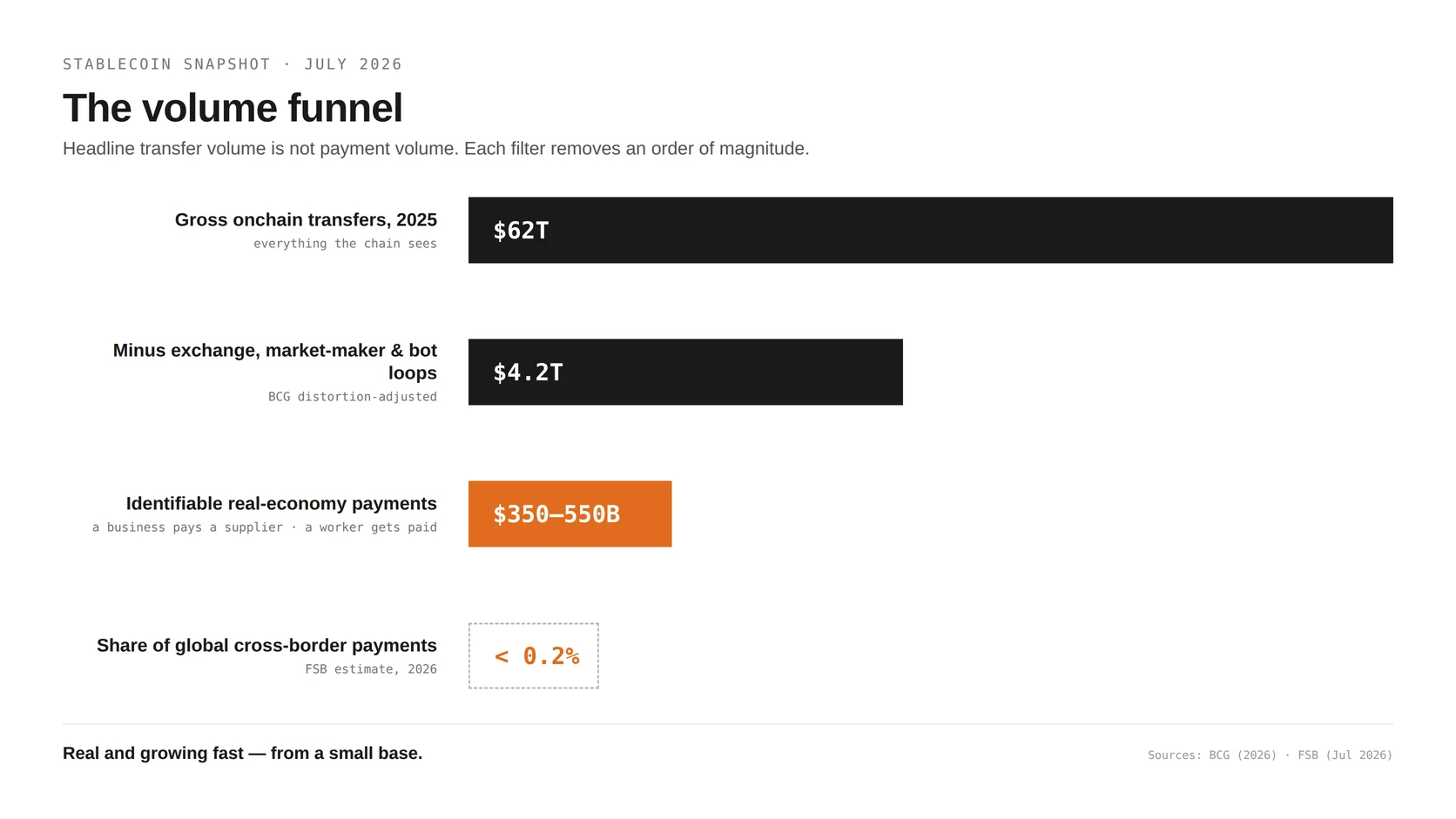
Every stablecoin pitch deck opens with the same number: $62 trillion in transfers in 2025. The number is real. It doesn't mean what people think it means.
Strip out exchange reshuffling, market-maker inventory moves, smart contract loops and bot activity, and BCG gets to roughly $4.2 trillion. Keep only identifiable bilateral real-economy payments — a business paying a supplier, a contractor receiving a payout — and you're at $350 to $550 billion. That's under 1% of the headline. The FSB lands in the same place from the opposite direction: stablecoins remain below 0.2% of total cross-border payments.
Visa's onchain analytics show the same pattern in live data. In a recent 30-day snapshot, roughly $5 trillion of gross transfer volume fell to $1.3 trillion after stripping bots, internal contract movements and exchange rebalancing — 26% of the headline. Transaction count fell from 1.5 billion to 199 million. And "adjusted" still doesn't mean payments: exchange deposits, DeFi, lending, minting and ramps all survive the filter. The most interesting slice is retail-sized transfers under $250: 134.9 million transactions moving $6.6 billion. That's 68% of adjusted transaction count and 0.5% of adjusted dollar value, at an average size of $49. Small-value usage is already broad. The value is still institutional.
DeFi Llama puts total supply at $309.9 billion as of July 28, with USDT at 59.3%. Supply is slightly below its recent peak. Adoption is real. It is not a straight exponential curve.
The honest framing: stablecoins are no longer an experiment, and they are not yet a material share of global payments. Both things are true. The interesting part is what happens in between.
2026 is the year the adults showed up
The question is no longer whether stablecoins can move value. That's settled. The question is whether regulated institutions can run stablecoin operations with the governance, approvals, auditability and liquidity controls they require. Four developments this year tell you where that's heading.
The biggest tell is the Visa Stablecoin Platform, launched in July: wallet infrastructure, minting, redemption, dual approvals, allowlists and audit logging, wired into existing settlement and treasury services. It initially supports Open USD and is in beta with selected clients. Institutions are not asking for a wallet API. They're asking for an operating environment that plugs stablecoins into the controls they already have. Visa's stablecoin settlement also hit a $7 billion annualized run rate by March, up 50% quarter over quarter — real validation, still immaterial next to Visa's total volume. The right interpretation: Visa isn't being replaced by stablecoins. Visa is becoming the interoperability layer between stablecoin balances and merchant acquiring.
Open USD launched June 30 with more than 140 participating businesses. Free minting and redemption, and — the important part — a share of reserve income goes to ecosystem participants. Historically the issuer kept all the reserve yield. Now wallets, processors, exchanges and distributors get a cut. That means payment pricing can drop below the standalone cost of the transfer, because reserve earnings subsidize it. Distribution is becoming more valuable than issuance. The caveat nobody prices in: this model is interest-rate-sensitive. When short rates fall, the subsidy falls with them.
JCB and Circle announced a July collaboration that starts with JCB's own cross-border treasury transfers. Notice the pattern. The first institutional use case is almost never consumers paying merchants in stablecoins. It's internal treasury and settlement. Stripe is expanding stablecoin-backed accounts from 101 to 150 countries and wiring them into Pix and UPI. Deel uses it to give contractors in 150+ countries dollar-denominated balances.
Regulation moved from principles to operating rules, with one nuance everyone gets wrong. The GENIUS Act was signed July 18, 2025 — but it takes effect on the earlier of January 18, 2027 or 120 days after final implementing rules, and the OCC only finished proposing the reserve, reporting and AML rule sets between February and June. So no, the US framework is not fully operational yet. Strategic clarity, incomplete operating detail. And on July 14, the UK and US published a joint statement: one-to-one backing, segregated reserves, protected redemption, and formal pathways for a stablecoin regulated in one jurisdiction to access the other. That's the first serious attempt to defragment the map.
The machine room behind a boring payment
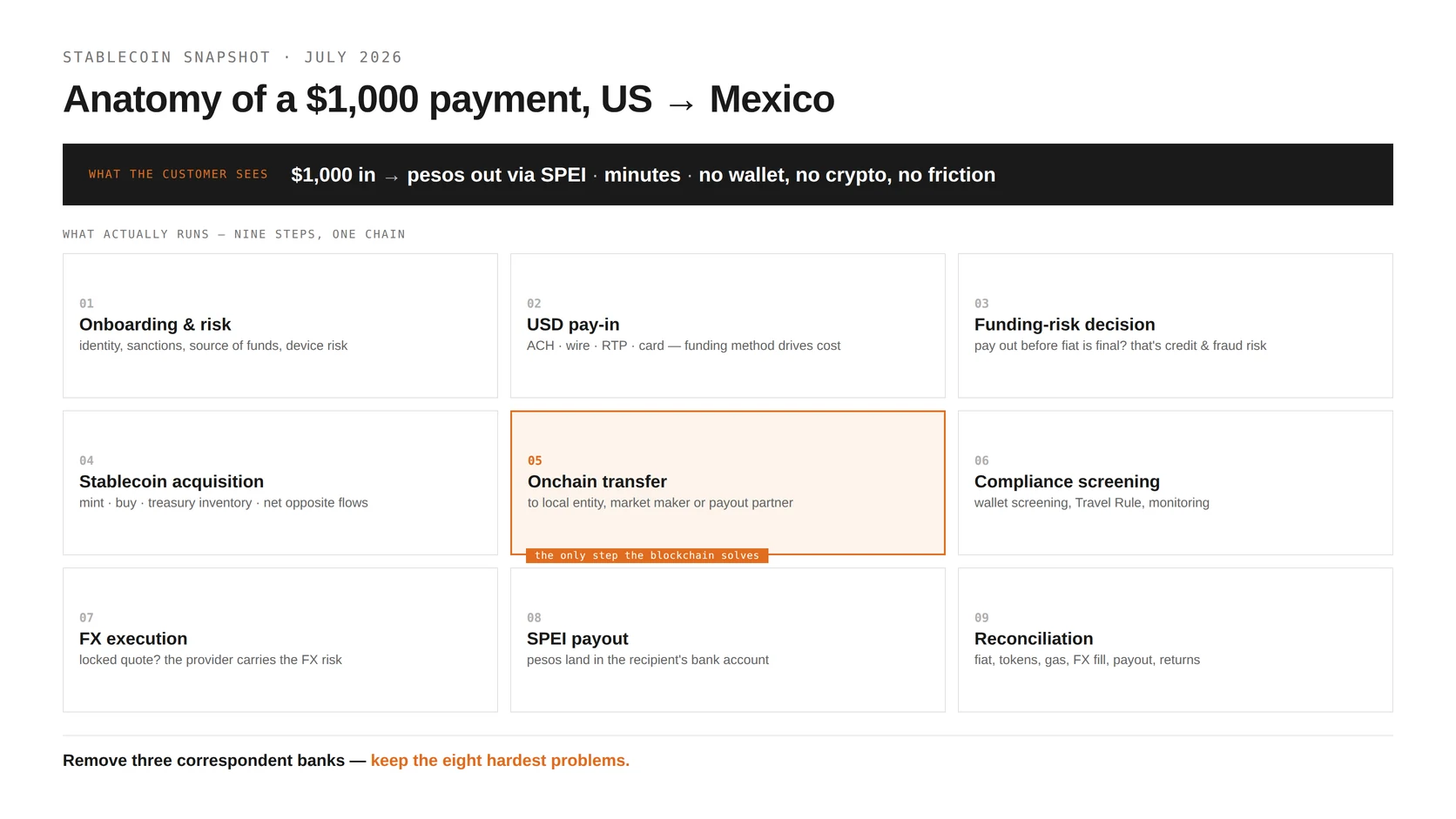
Take a US-to-Mexico payment. Here's the customer experience:
The sender pays $1,000. The recipient gets pesos in their bank account via SPEI, usually within minutes. Neither side knows a stablecoin existed.
The industry has a name for this shape: the stablecoin sandwich. Fiat in, stablecoin settlement in the middle, local fiat out. The token is an implementation detail.
Here's what actually happens. Onboarding and risk checks: identity, sanctions, source of funds, device risk. USD pay-in: ACH, wire, RTP, card or existing balance — and the funding method drives the economics, because ACH is cheap but settles slowly while a card is instant but brings interchange and chargeback exposure. Then the decision most diagrams skip: does the provider pay out before the sender's money is irrevocably final? If yes, the provider just converted a settlement delay into a credit and fraud decision.
Then the stablecoin leg. Mint with the issuer, buy from a liquidity provider, use treasury inventory, or net against opposite-direction flows. Move it onchain to the local entity or payout partner, through wallet screening and Travel Rule checks. Execute the FX — and if the customer quote was locked up front, the provider carries that risk too. Pay out MXN through SPEI. Then reconcile everything: fiat receipt, token amount, gas, FX fill, payout confirmation, returns.
The blockchain solves exactly one of those nine steps.
One measurement trap worth naming: settlement speed is not payment speed. The chain reaches finality in seconds, but the ACH may still be returnable, compliance may hold the transfer, the payout bank may reject the account. The metric that matters is authorization to confirmed availability of funds — and that's an end-to-end number, not a block time.
You can remove three correspondent banks and still keep the hardest problems: identity, fraud, FX, liquidity, payout reliability, reconciliation.
Do the math on the whole chain, not the blockchain
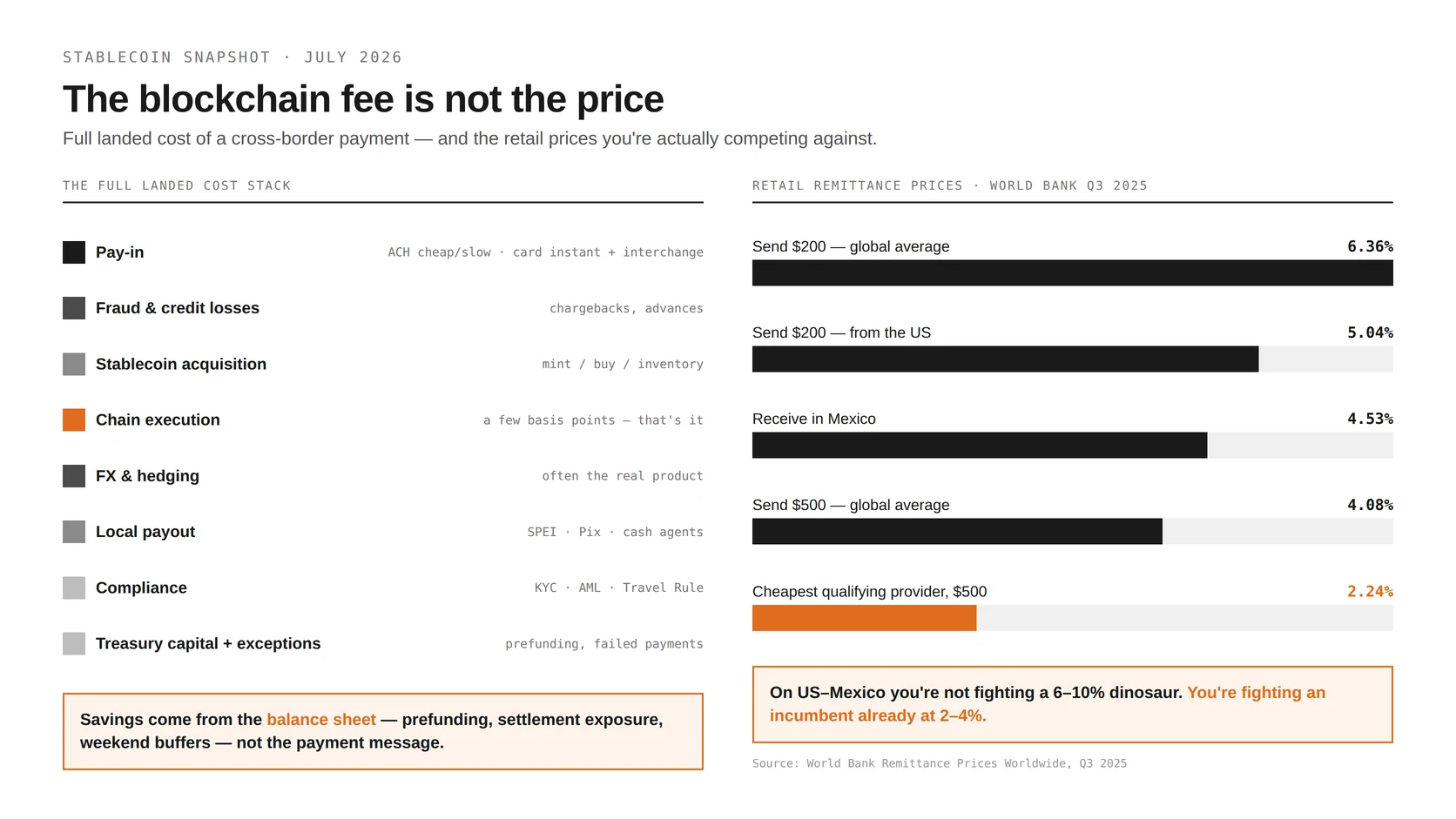
The wrong comparison is a network fee against a Western Union retail price. The right one is the full landed cost: pay-in, fraud and credit losses, stablecoin acquisition, chain execution, FX and hedging, local payout, compliance, treasury capital, and exception handling. The chain component is a few basis points. Everything else is the price.
Which is why the World Bank numbers matter. The latest remittance pricing data puts the global average cost of sending $200 at 6.36%. But US–Mexico is a mature, competitive corridor: about 4.54% for a $200 transfer and 2.99% for $500, with some digital providers materially below that. A stablecoin entrant is not competing against a slow 8–10% bank wire. It's competing against optimized fintechs already pricing bank payout at a few percentage points — or less.
So where do stablecoins actually save money? Not the payment message — the balance sheet. Correspondent charges, settlement delays, weekend liquidity buffers, intraday credit exposure, the size and duration of prefunding, manual treasury work. Saving 10 basis points on $1 billion of annual volume is $1 million. Eliminating two days of prefunding across several corridors can be worth far more than that in return on capital.
Prefunding doesn't disappear. It moves.
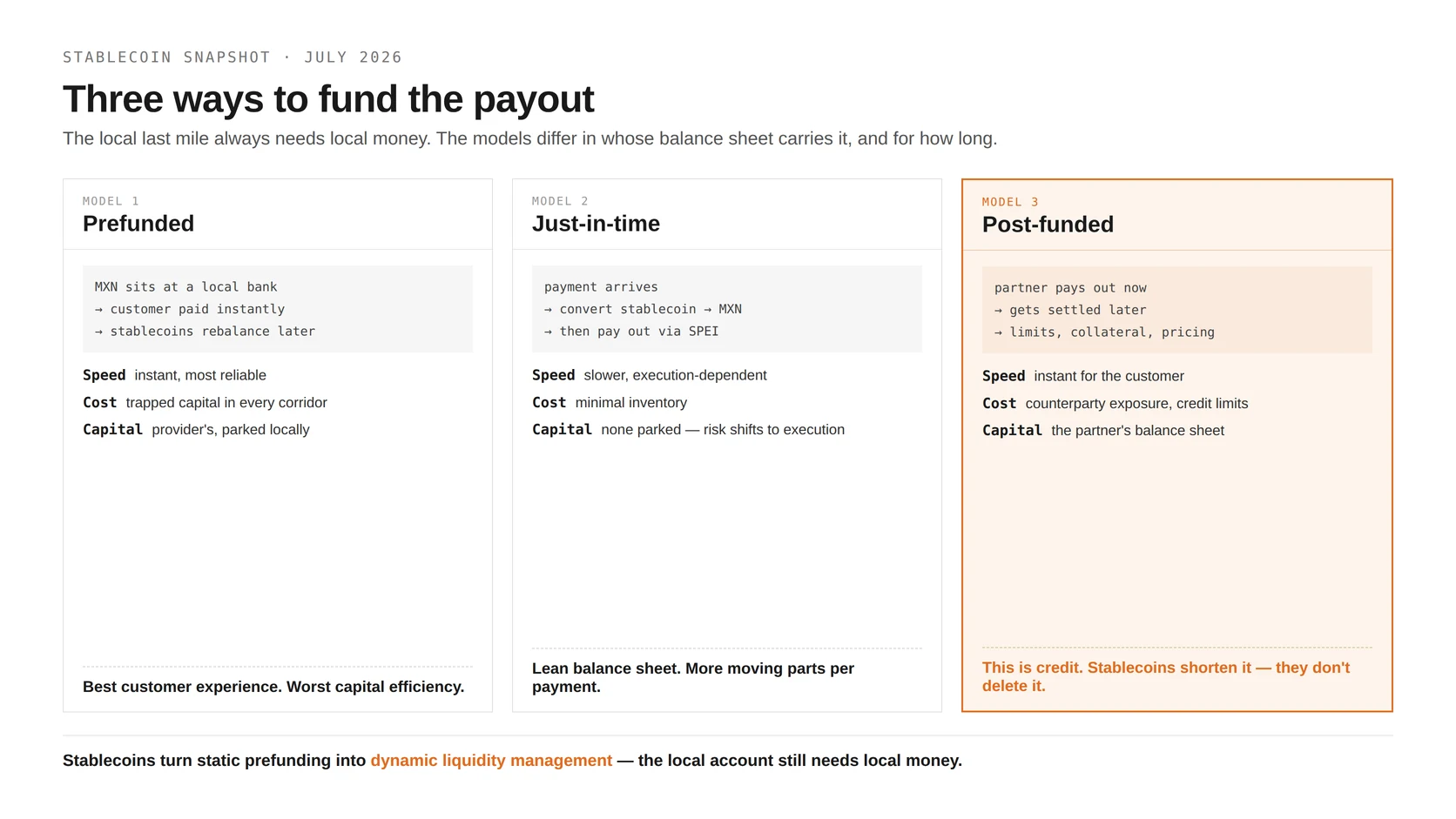
Three operating models cover almost everyone in production. Prefunded: MXN sits at a Mexican bank or payout partner, the customer gets instant reliable payout, and the provider eats trapped capital. Just-in-time: convert stablecoin to pesos per payment — less inventory, more execution dependencies, slower. Post-funded: the partner pays out now and gets settled later.
That last one gets marketed as innovation. It isn't.
Post-funding is credit. Someone is extending balance sheet, setting limits and pricing counterparty risk. Stablecoins shorten the exposure. They don't delete it.
The precise claim: stablecoins turn static prefunding into dynamic liquidity management — centralized treasury, after-hours replenishment, smaller precautionary buffers, faster netting across partners. Visa is literally testing this as an alternative to making payment businesses pre-deposit fiat in every market. But a SPEI payout still needs pesos somewhere in the Mexican banking system. The local last mile always needs local money.
And 24/7 cuts both ways. A chain that never closes is only an advantage if your treasury, compliance and incident response never close either. Otherwise Sunday settlement just means wider weekend spreads.
Every corridor is a different product
US–Mexico is a mature corridor with excellent domestic rails. Incumbents are already fast, so "instant remittances" isn't the value proposition. Treasury rebalancing is. 24/7 liquidity, B2B supplier payments, lower working capital, programmatic reconciliation. The binding constraints are the USD/MXN spread, licensing and banking relationships — not blockchain throughput.
Brazil has a world-class last mile in Pix, and the central bank pulled virtual assets into the FX and reporting perimeter — rules effective February, expanded reporting since May. The lesson inverts the usual logic: the better the domestic rail, the more valuable the stablecoin bridge, and the more the work becomes regulatory integration rather than technology.
Argentina and other dollar-demand markets are different again, because remittances overlap with capital preservation. An IMF/BIS study this year found over 70% of fiat-to-stablecoin conversions originate in non-dollar currencies, and estimated that a 1% exogenous increase in net stablecoin inflows moves stablecoin/local-fiat parity deviations by roughly 40 basis points — stronger in emerging markets. Translation: in stressed markets, stablecoins are not neutral plumbing. They create a continuously traded offshore dollar price and can amplify the local premium. Bitso's retail data shows what that looks like on the ground: USD stablecoins drove about 40% of customer acquisitions across Argentina, Brazil, Colombia and Mexico — ahead of Bitcoin at 18%.
Europe is the opposite case. SEPA Instant already works, so the incremental value is treasury, non-European settlement and out-of-hours liquidity. And MiCA reshuffled the deck: regulated-facing activity shifted from USDT toward USDC even though global totals barely moved.
Which answers the USDT-versus-USDC question. It's not philosophy, it's routing. USDT gives you depth in emerging markets and Tron, which went from roughly 74% of identifiable real-economy flows at the start of 2025 to about 60% by year-end — absolute volume still growing, but incremental enterprise growth is landing on Ethereum, Solana, BNB Chain and Polygon. USDC gives you institutional integration and regulated US and European channels. The mature architecture does policy-based routing across both, chosen per corridor on redemption access, liquidity and legal treatment — and avoids wrapped-asset and bridge exposure it doesn't need.
Where I'm probably wrong
The estimates fight each other. BCG's $350–550 billion and the FSB's sub-0.2% use different methodologies, and the true number could easily be double in either direction. The growth rate matters more than the level — BCG has B2B, the largest category at 40% of real-economy flows, growing 65% year over year, and C2C at 75% — and I might be anchoring on the level.
I might be underestimating consumer checkout. Stablecoin-linked cards abstract away the entire crypto layer: the consumer never touches a wallet, the merchant never touches a token. If that's the adoption path, "consumers won't hold stablecoins" is true and completely irrelevant.
I might be overweighting the reserve-income model. Open USD's economics depend on rates staying meaningful. If short rates collapse, the subsidy evaporates and issuance economics get fought over again.
And regulation could move faster than my timeline. If GENIUS rulemaking lands cleanly and the UK–US pathway becomes real, bank participation could compress my two-to-three-year horizon into twelve months.
What I'm watching
Whether Open USD's 140-plus participants convert into actual supply share against USDT and USDC, or stay a press release.
Whether the Visa Stablecoin Platform graduates from beta, and whether the $7 billion settlement run rate keeps compounding. Four more quarters of 50% quarter-over-quarter growth and the word "immaterial" expires.
The GENIUS Act clock: 120 days after final rules, against the January 2027 backstop. Banks are waiting for that starting gun.
B2B's share of real-economy flows. At 40% and growing fastest, if it crosses half, the "stablecoins are for remittances" narrative is dead.
And Mexico's Senate initiative on peso-referenced stable tokens from May. Banxico is still cautious, but if a regulated peso leg appears, the largest US corridor changes shape entirely.
The winners of this phase won't look like crypto applications. They'll look like globally integrated financial institutions with programmable settlement — and the stablecoin itself will be the most replaceable part of the stack.