TL;DR The "AI race" between the US and China is a misleading frame. They're not running the same race. China is embedding AI into centralized state infrastructure to predict and preempt. The West (at its best) is building decentralized systems that preserve individual agency. Same technologies, opposite civilizational assumptions. Builders who only understand one operating system are designing for half the world.
I spend my days building Bitcoin infrastructure at Block. Permissionless payments. Censorship-resistant money. The whole architecture assumes that individuals, not institutions, should control their financial lives. Then I read Jan Krikke's essay on China's "Predictive State" and the contrast hit hard: China is using the same underlying technologies (cryptography, distributed systems, AI) to build the exact opposite.
This isn't a race. It's a fork.
The destination matters more than the speed
Krikke's core argument is that the "AI race" framing mischaracterizes what's happening. Silicon Valley asks: can machines rival human cognition? Beijing asks: how do we embed intelligence into national infrastructure? One is frontier exploration. The other is systemic integration.
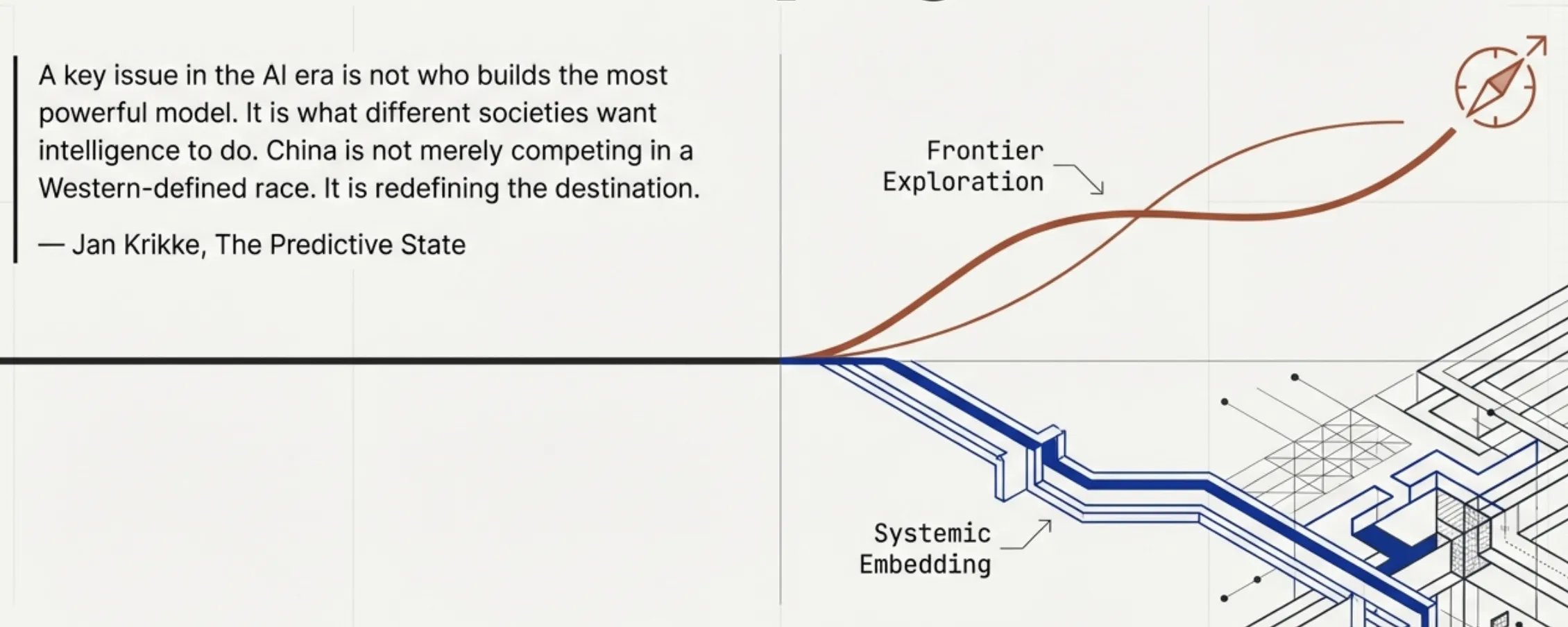
Look at the numbers. China invested $125 billion in AI in 2025, with 39% coming from government funding. DeepSeek trained R1, a reasoning model that matched OpenAI's o1 on math and code tasks, for a reported $6 million. ARK Invest found that nine of the top ten open-weight models globally now originate from China. But the model leaderboard isn't the point. The point is what happens after the model ships.
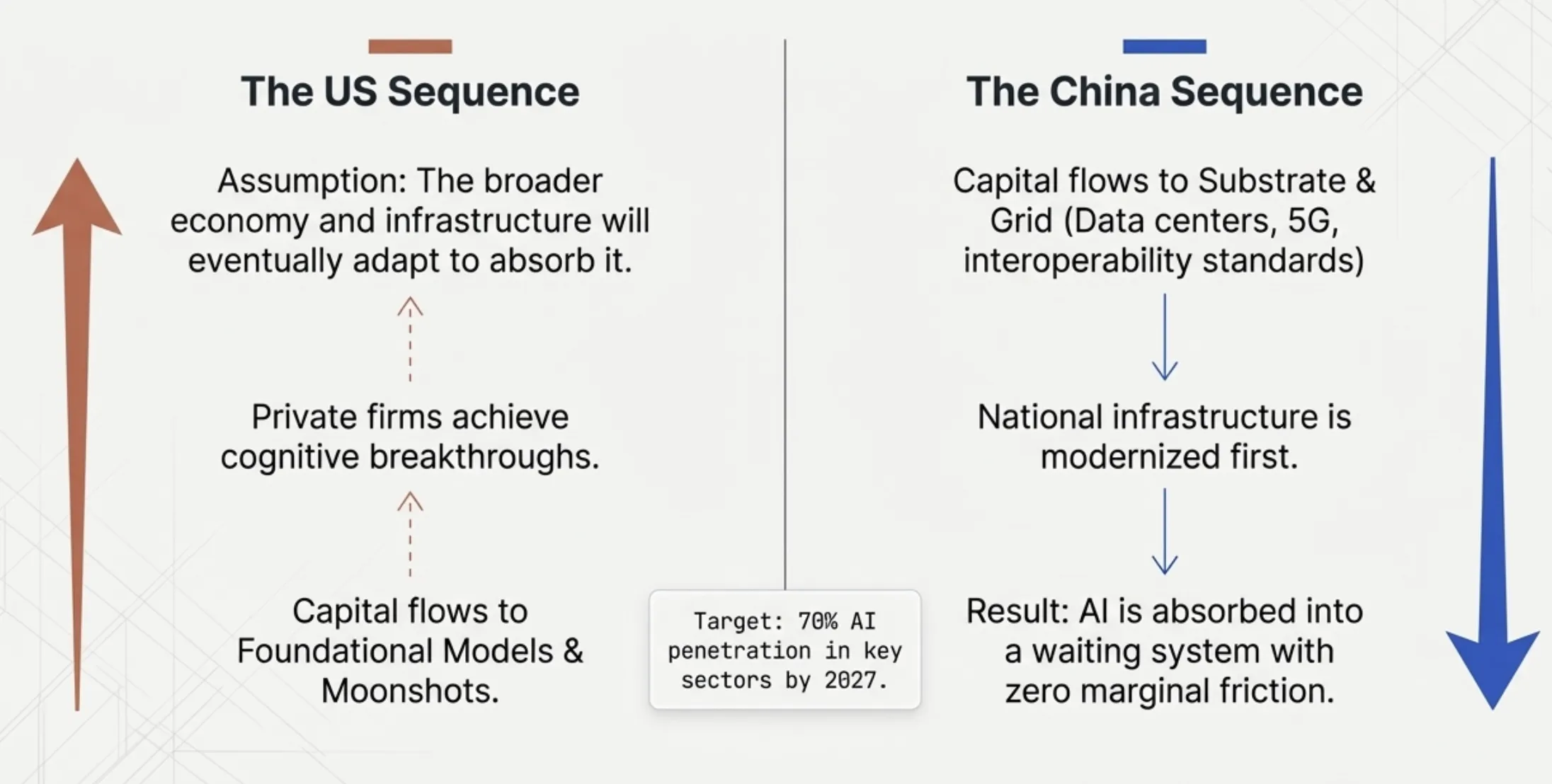
China's approach inverts the US innovation sequence. Before AI transforms society, you build the substrate: data centers, connectivity, interoperability standards, digital identity platforms. Capital-intensive upfront, low marginal deployment cost afterward. The US channels capital toward foundational models and moonshots, assuming the rest of the economy will adapt. China builds the rails first, then runs the trains.
Same tools, opposite philosophy
The blockchain dimension makes this clearest. China embraces blockchain's technology while rejecting its philosophy. The Blockchain-based Service Network operates across 120 public city nodes, backed by China Mobile and China UnionPay. It offers standardized, low-cost blockchain deployment with no cryptocurrency attached. Permissioned architecture. State-supervised. A $54.5 billion national blockchain roadmap targets full operational infrastructure by 2029.
Compare that to what we build at Block, or what the broader Bitcoin ecosystem represents. Same cryptographic primitives, same distributed ledger concepts. Opposite purpose. China wants the transparency of the ledger pointed at citizens. Bitcoin wants it pointed at institutions. China's digital yuan processed 3.48 billion transactions and $2.38 trillion in cumulative value by late 2025, with 230 million individual users. It's not experimental. It's operating at nation-state scale.
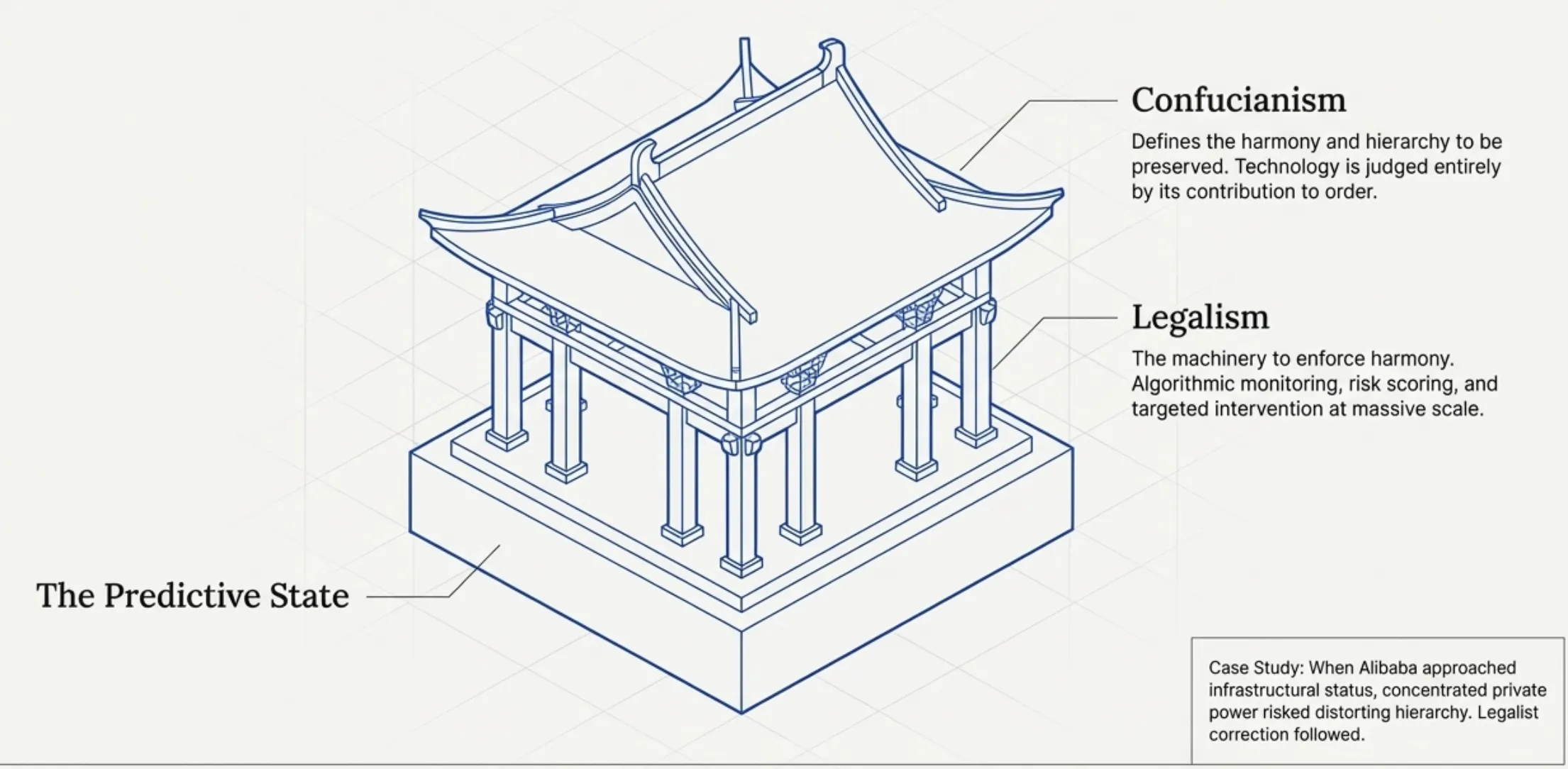
Krikke frames China's governance philosophy as Confucian-Legalist: Confucianism defines the harmony to be preserved, Legalism provides the instruments to preserve it. The Alibaba case is instructive. Beijing encouraged Alibaba to grow, digitize sectors, become infrastructure. Then, when concentrated private power risked distorting the hierarchy, antitrust actions and restructuring mandates followed. The state giveth, the state correcteth.
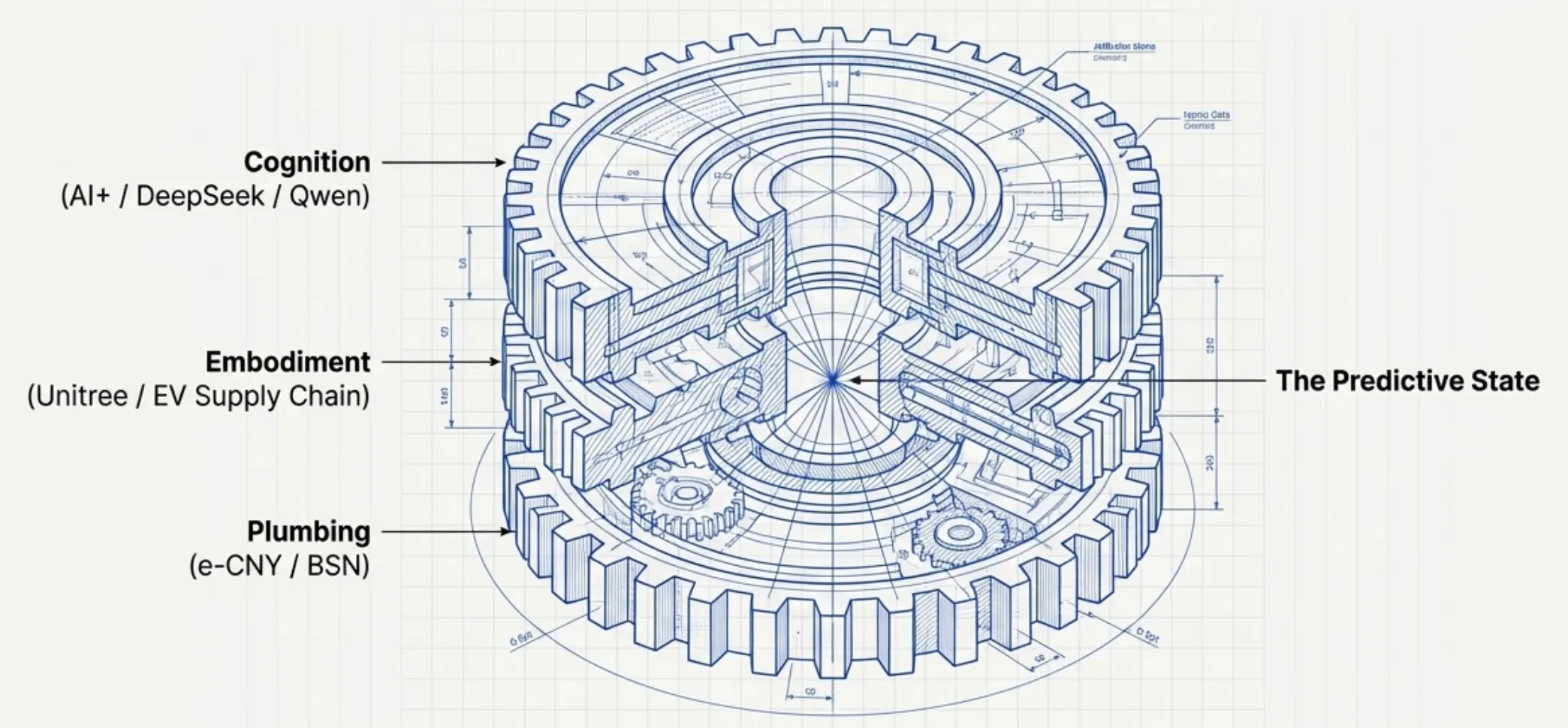
The "Predictive State" is the logical endpoint. Traditional governance is reactive. Krikke's concept "aims to detect deviations before they crystallize into instability". Digital identity platforms, integrated payments, sensor networks render society "computationally legible". The citizen bargain, in Krikke's framing, is "not simply privacy for convenience. It is visibility for inclusion".
The hardware gap is real and accelerating
The conceptual divergence is interesting. The manufacturing gap is the part that should worry you.
In 2025, Chinese companies captured 80-90% of global humanoid robot shipments. Unitree Robotics shipped approximately 5,500 units. US companies (Figure AI, Agility Robotics, Tesla) shipped around 150 each. That's a 36x gap. XPENG plans initial capacity of 50,000 units per year. LinLingyi iTech is planning factories for 500,000 annual capacity.
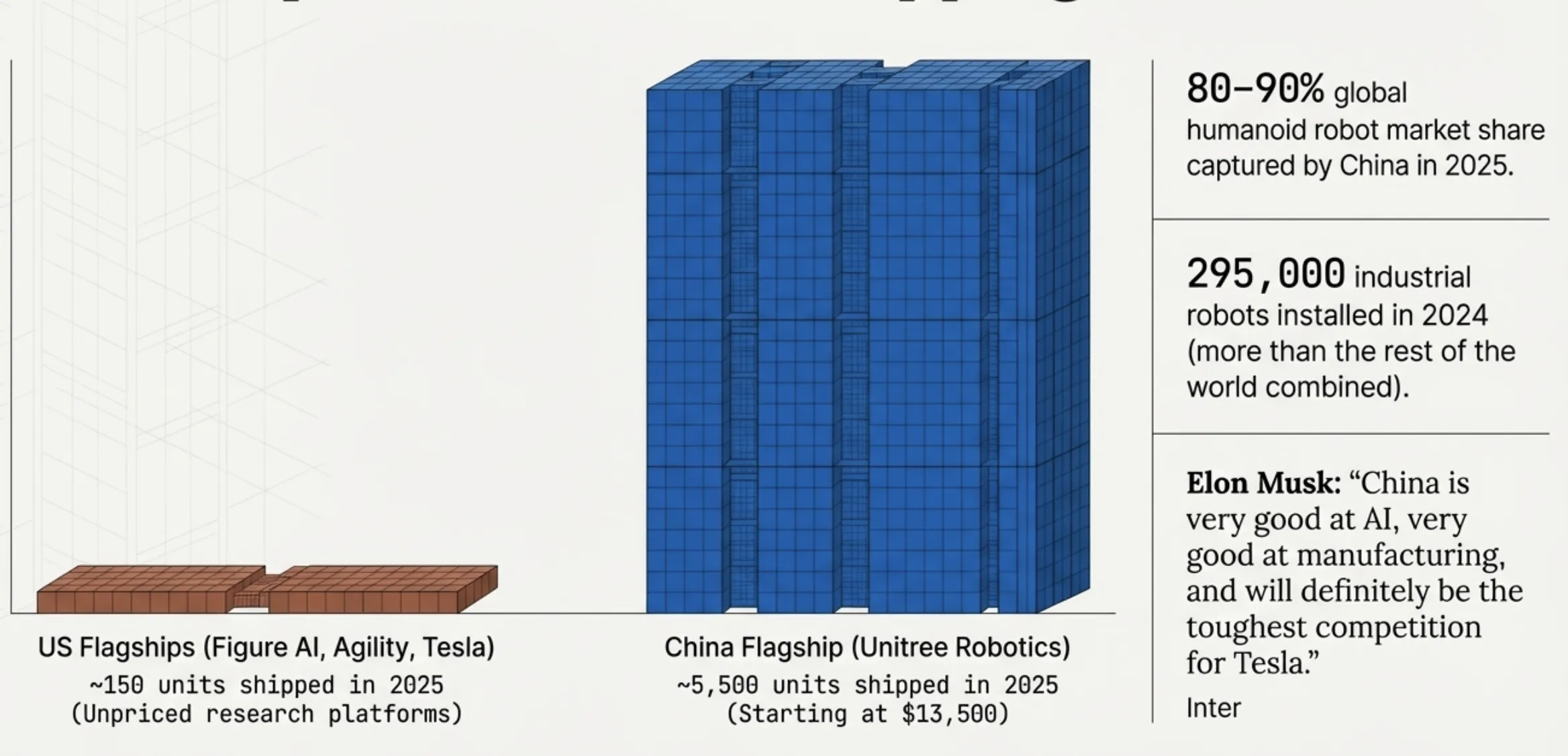
This is the EV playbook repeating. China's robotics advantage is built on its EV supply chain: sensors, batteries, electric actuators are exactly the components humanoid robots need. Shenzhen can design, prototype, manufacture a new component in roughly a third the time of a Silicon Valley firm. Government support is direct: the 15th Five-Year Plan elevated robotics to one of eight strategic emerging industries, with dedicated billion-dollar funds from Shenzhen and Beijing. A separate $8.2 billion National AI Industry Investment Fund launched in January 2026.
Musk acknowledged it plainly: "China is very good at AI, very good at manufacturing, and will definitely be the toughest competition for Tesla".
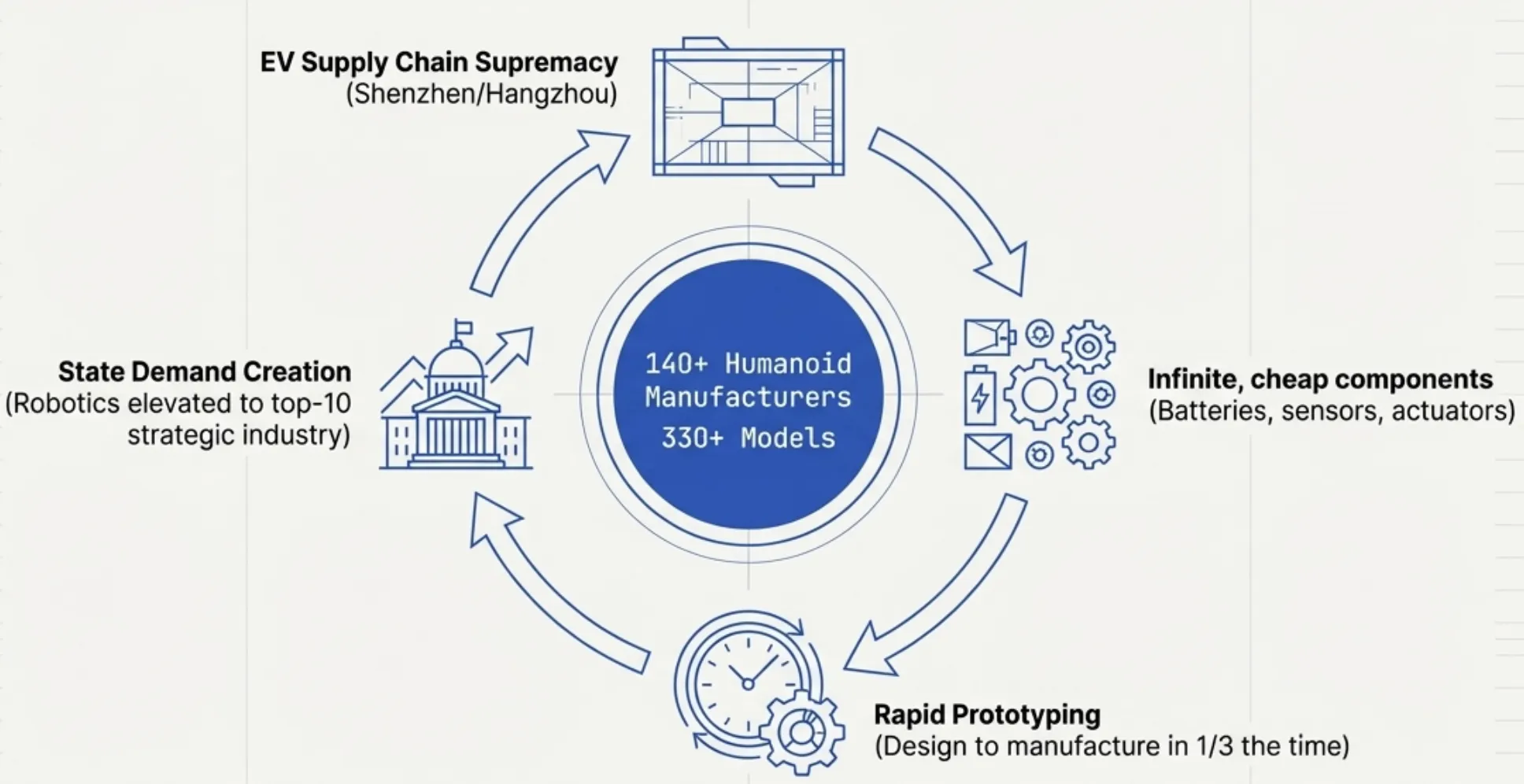
The coordination advantage is structural. When your state, your supply chain, your capital markets all share a single optimization function, you move fast. The question is whether you move toward the right destination. Leopold Aschenbrenner made the case that AI development is becoming a national security race with existential stakes. That frame is useful for understanding urgency, but it can obscure the deeper divergence: the race metaphor assumes a shared finish line.
What decentralization actually has to offer
Centralized systems optimize brilliantly within known parameters. Krikke concedes this: predictive systems "excel within the boundaries of the known", but "history includes rupture as well as continuity. Financial crises evade models".
This is where the decentralized operating system earns its keep. Bitcoin didn't emerge from a government roadmap. Neither did the open-source AI movement that DeepSeek itself benefited from (R1 shipped under MIT License). Permissionless systems are messy, slower to deploy, harder to coordinate. But they surface information that centralized systems suppress.
When expertise gets encoded in state-managed software, Krikke admits, "tacit knowledge erodes". In a decentralized system, tacit knowledge is the competitive advantage. The builder who understands why a protocol works a certain way, not just that it does, creates value that no amount of centralized deployment can replicate. There's a reason China has 140 humanoid robot manufacturers but the foundational AI research that made them possible (transformers, reinforcement learning from human feedback, diffusion models) originated in Western labs operating with minimal state direction.
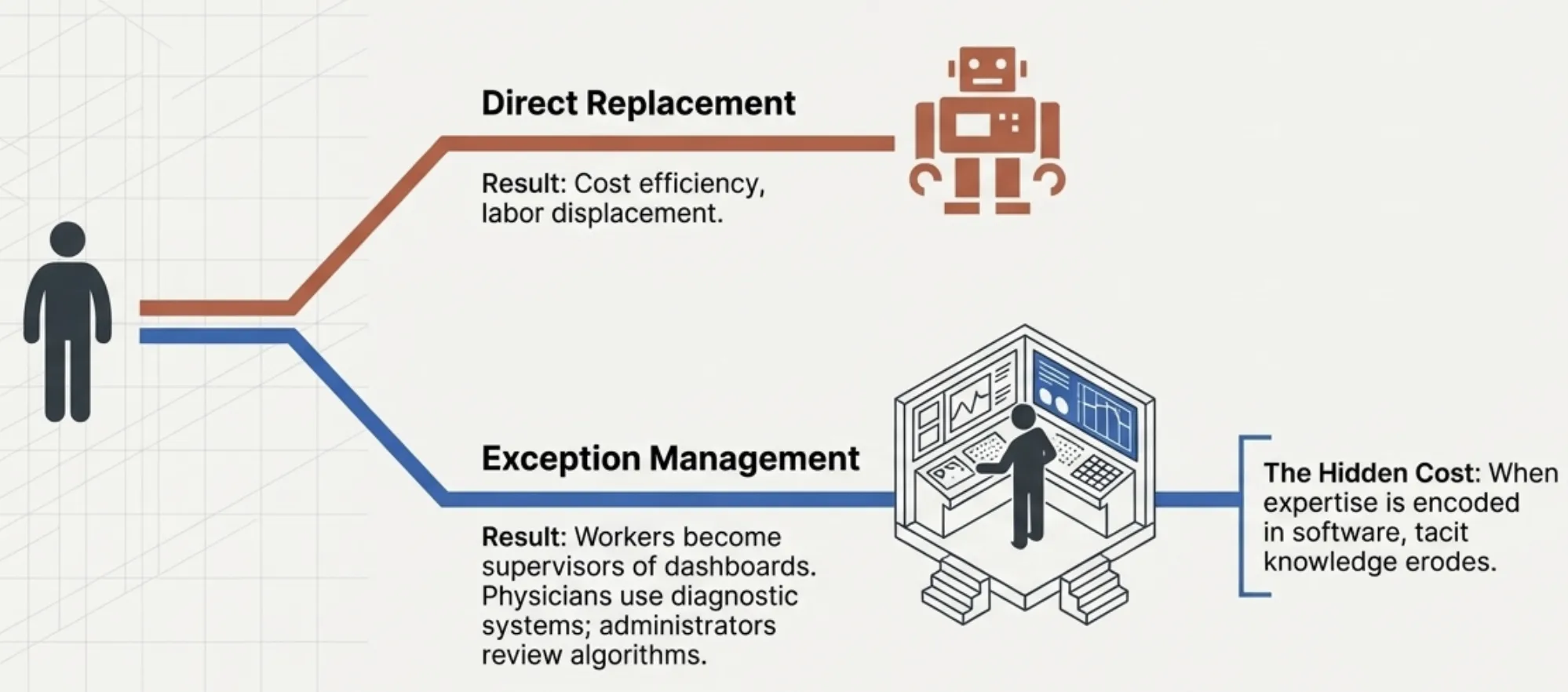
Innovation that nobody planned for is the one thing centralized systems structurally cannot produce.
Jeffrey Ding's research argues that a nation's ability to diffuse AI across its economy may matter more for long-term power than frontier model capability alone. By that measure, China's infrastructure-first approach is a serious strategy, not just a consolation prize for trailing on benchmarks.
Where this argument breaks down
The biggest gap in the decentralization thesis: it assumes that individual agency scales. In practice, most people don't want sovereignty over their financial infrastructure. They want it to work. China's 230 million digital yuan users didn't sign up for a philosophy. They signed up for convenience. The "visibility for inclusion" bargain is a real bargain for hundreds of millions of people who were previously unbanked or underserved by legacy financial systems.
There's also a speed problem. Krikke quotes the observation that "what might take a decade to test in the US could happen in two to three years in China". Fewer privacy constraints, massive data pools, integrated state-industry coordination. If decentralized systems can't ship at a pace that matters, the centralized alternative wins by default. Not because it's better. Because it's there.
And the "two operating systems" frame itself is too clean. China's most consequential AI company, DeepSeek, open-sourced its models under a permissive Western license. Chinese developers contribute to Western open-source projects. Western companies manufacture in Shenzhen. The actual picture is messier than any binary allows. Real builders operate across both systems simultaneously.
Finally, romanticizing decentralization ignores its failure modes. Crypto's worst moments (exchange collapses, rug pulls, unregulated leverage) are what happens when you remove the Legalist correction that Krikke describes. The question isn't whether guardrails are needed. It's who holds them and what they optimize for.
The mirror reflects the builder
Krikke ends his essay with a metaphor: "AI serves as a mirror, reflecting how civilizations define progress". He's right, but the mirror isn't only civilizational. It's personal.
Every system you build encodes an assumption about what intelligence is for. Control or agency, prediction or exploration. Legibility to the state or sovereignty of the individual. You don't get to avoid the choice by pretending it's just engineering.
The builders who will matter most in the next decade are the ones who understand both operating systems well enough to make that choice deliberately.